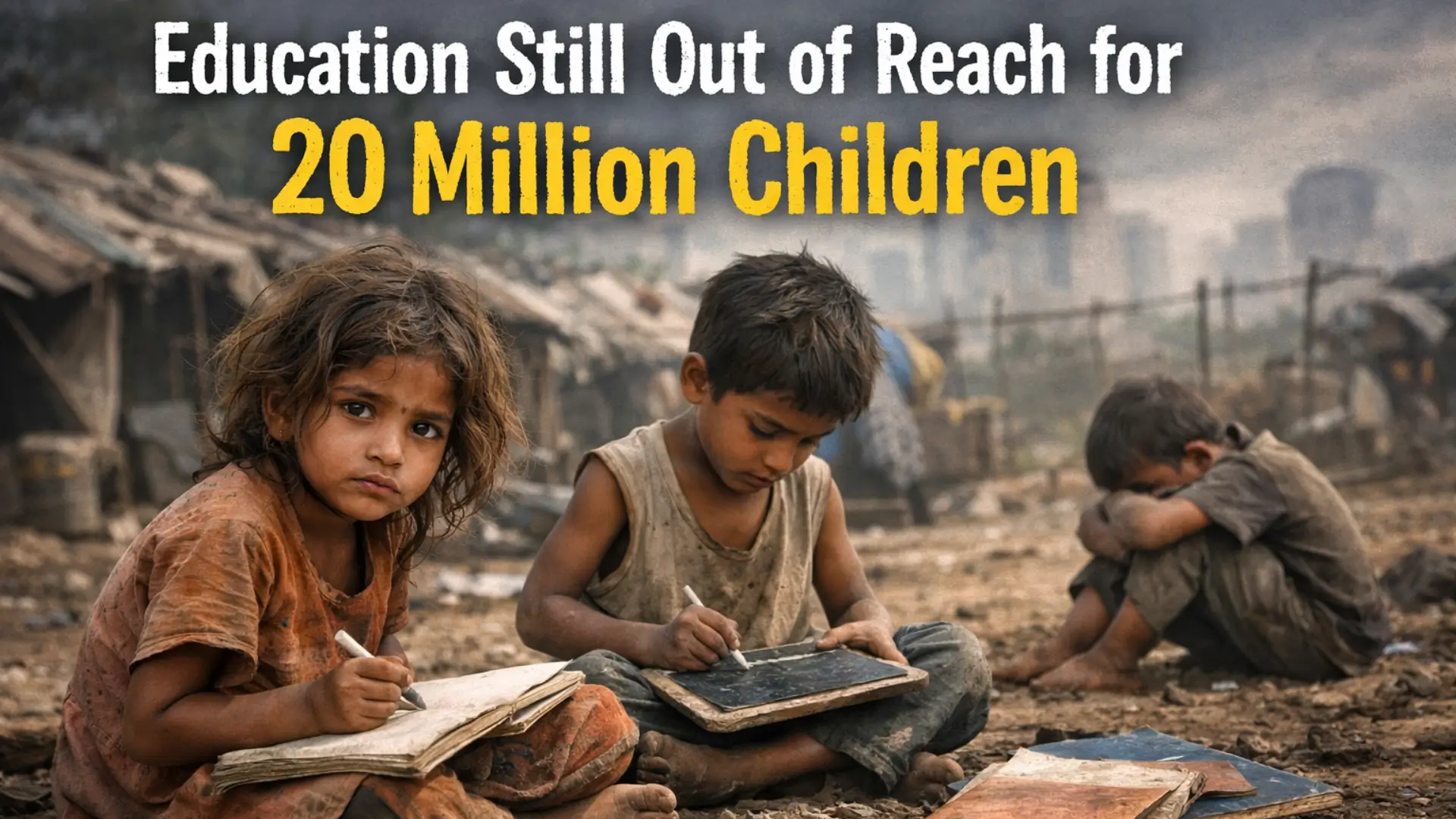
Education Still Out of Reach for 20 Million Children. A recent official survey has revealed that while the number of out-of-school children in Pakistan has declined slightly, food insecurity has surged across all provinces. According to the Household Integrated Economic Survey (HIES) conducted between September 2024 and June 2025, the total number of children not attending school has dropped from 25.3 million to around 20 million, based on updated population figures from the 2023 census.

The survey comes after a six-year hiatus and was released following encouragement from the International Monetary Fund (IMF).
School Enrollment Shows Modest Improvement
The HIES report indicates a small improvement in school enrollment, with the national out-of-school rate declining from 30% to 28%. Despite this progress, disparities remain significant across regions and genders:
- Gender disparities: One in four boys and nearly one in three girls are still out of school. Rural girls in Sindh and Balochistan face the highest levels of exclusion.
- Provincial trends:
- Punjab’s rate remained unchanged at 21%, still the lowest nationally.
- Sindh improved slightly from 42% to 39%.
- Khyber Pakhtunkhwa (KP) reduced its rate from 31% to 28%.
- Balochistan showed the largest improvement, dropping from 59% to 45%.
Of the 28% out-of-school children, 20% have never enrolled, while 8% dropped out. Boys often leave school to work or due to high education costs, whereas girls primarily drop out because of financial hardship and family restrictions.

Literacy and Educational Attainment
The survey highlighted overall gains in educational participation:
- The proportion of people aged 10 and above who have ever attended school rose from 61% to 67%.
- Literacy increased modestly from 60% to 63%.
Planning Minister Ahsan Iqbal described these gains as inadequate, emphasizing that sustainable economic growth is impossible without higher literacy rates.
Food Insecurity Reaches Alarming Levels
The survey also revealed a sharp rise in food insecurity, largely due to prolonged inflation and slow economic growth. Nearly one-fourth of households now face moderate or severe food insecurity:

- Punjab: Food insecurity rose from 14.4% to 22.6%, with severe cases almost doubling.
- Khyber Pakhtunkhwa: Increased from 16.7% to 21.5%.
- Sindh: Rose by 10% to 29%.
- Balochistan: Most alarming, food insecurity doubled to over 30%.
Low-income households remain almost five times more vulnerable than wealthy households.
Digital Connectivity and Inclusion Challenges
Despite government efforts to promote a digital Pakistan, connectivity and digital access remain uneven:
- Mobile phone usage dropped from 91% to 83%.
- Only 12% of individuals own a bank account, and 9% use mobile money services.
- Household-level internet access improved from 34% to 69%, and mobile access increased to 96%.
- Computer ownership fell sharply to 7%, and digital skills, especially among women, remain limited.
Health and Population Welfare Improvements
The survey also reported positive developments in health and welfare indicators:

- Infant mortality declined from 60 to 47 deaths per 1,000 live births.
- Overall mortality decreased from 41 to 35.
- Access to water within household premises improved from 74% to 79%.
These improvements indicate gradual progress in population welfare, although challenges remain.
FAQs
Q1: How many children are currently out of school in Pakistan?
Approximately 20 million children, which accounts for 28% of the total child population.
Q2: Which province has the highest out-of-school rate?
Balochistan, with a current rate of 45%, followed by Sindh at 39%.

Q3: What are the main reasons for school dropout?
Boys often leave school for work or due to high education costs. Girls drop out primarily because of financial hardship and family restrictions.
Q4: Has literacy improved in Pakistan recently?
Yes, literacy has increased slightly from 60% to 63%, and overall school attendance rose from 61% to 67%.
Q5: Which province faces the most severe food insecurity?
Balochistan, where over 30% of households face moderate to severe food insecurity.

Conclusion
While Pakistan has made modest gains in reducing the number of out-of-school children, the nation still faces significant educational, economic, and social challenges. Persistent gender and regional disparities, rising food insecurity, and limited digital access threaten sustainable development. To achieve long-term growth and equitable social progress, Pakistan must prioritize education, nutrition, and digital inclusion, especially for rural and low-income communities.