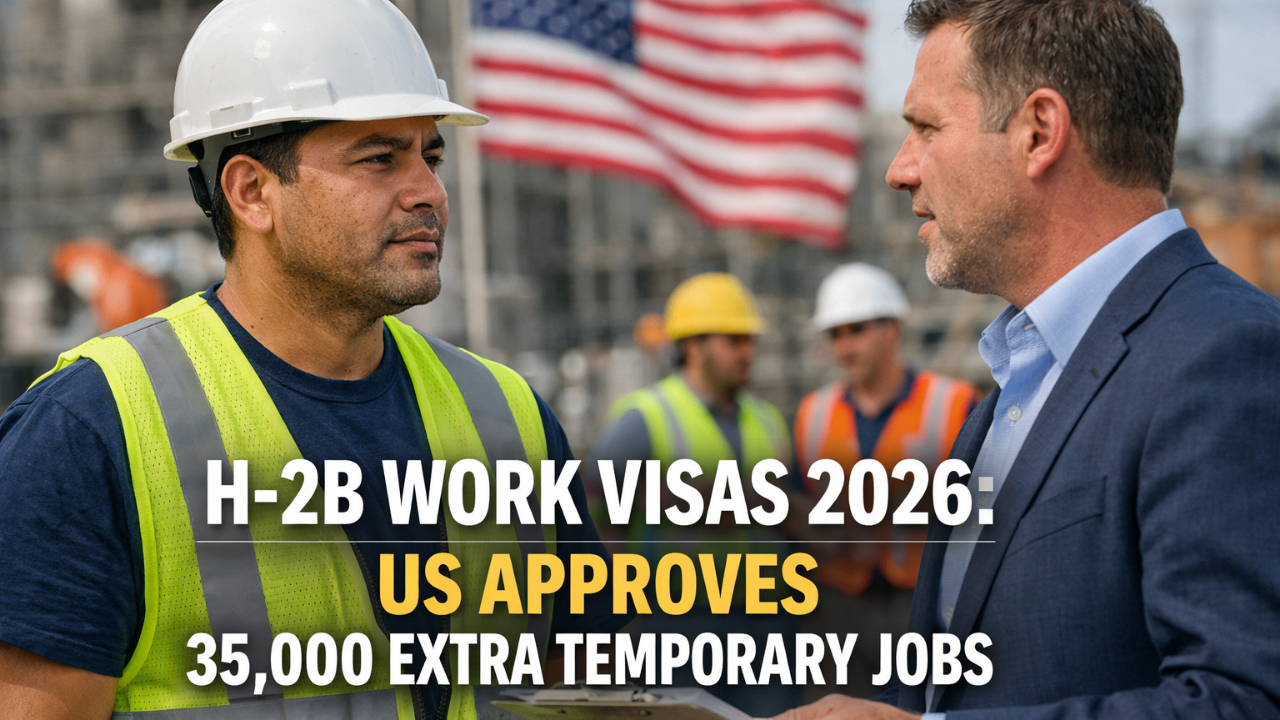
The announcement regarding H-2B work visas 2026 has drawn strong attention from US employers and foreign workers seeking temporary job opportunities. The United States government has confirmed that an additional 35,000 H-2B temporary work visas will be released in fiscal year 2026 to help industries struggling with seasonal labor shortages.

While this increase offers some relief, it also signals a shift in policy. Compared to previous years, the 2026 expansion is significantly smaller, making early planning and accurate applications more important than ever.
H-2B Work Visas 2026: Official Government Confirmation
The decision to release extra H-2B work visas 2026 was jointly announced by the Department of Homeland Security and the Department of Labor.
Key Details at a Glance
- Regular annual cap: 66,000 visas
- Additional visas for 2026: 35,000
- Total possible visas: 101,000
- Applicable to: Temporary, non-agricultural jobs
Although the increase helps ease workforce pressure, it is nearly 50% lower than supplemental visa numbers released between 2023 and 2025.

What Are H-2B Work Visas? (Simple Explanation)
The H-2B work visas 2026 program allows US employers to hire foreign nationals for temporary, non-agricultural roles when qualified American workers are unavailable.
Main Features of the H-2B Program
- Employer-sponsored visa
- Seasonal or peak-load employment
- Time-limited work authorization
- Mandatory return after job completion
- Subject to strict annual caps
This program is critical for industries that experience predictable labor shortages during specific times of the year.
Industries That Depend on H-2B Work Visas 2026
Several US industries rely heavily on temporary foreign workers to maintain operations. The additional visas for 2026 are expected to be allocated mainly to essential sectors.

Priority Sectors
- Hospitality and tourism
- Landscaping and grounds maintenance
- Seafood and food processing
- Forestry and logging services
- Construction support roles
- Manufacturing and warehouse support
- Amusement parks and recreation services
Because demand far exceeds supply, competition for H-2B work visas 2026 is expected to be intense.
Why the H-2B Visa Increase Is Smaller in 2026
Unlike the previous three years, the 2026 allocation reflects a more cautious approach by US authorities.
Possible Reasons Behind the Reduction
- Shifting labor market conditions
- Increased scrutiny of temporary visa programs
- Administrative and processing limitations
- Political pressure surrounding immigration policy
For employers, this means tighter filing windows and less margin for error.

Eligibility Requirements for H-2B Work Visas 2026
Not every foreign worker is eligible for the H-2B program. Only nationals of countries approved by DHS can apply.
Examples of Eligible Countries
- Mexico
- Jamaica
- Philippines
- Thailand
- Brazil
- United Kingdom
- Japan
Countries Not Currently Eligible
- India
- China
- Pakistan
- Bangladesh
Applicants must also meet job-specific qualifications and agree to return home after their authorized employment ends.
Impact of H-2B Work Visas 2026 on US Employers
Even with 35,000 additional visas, many employers remain concerned about staffing shortages.

Challenges Employers May Face
- Limited visa availability
- Faster application deadlines
- Higher legal and compliance costs
- Risk of delayed or denied petitions
Employers who fail to prepare early may struggle to secure workers during peak seasons.
What H-2B Work Visas 2026 Mean for Foreign Workers
For foreign nationals, H-2B work visas 2026 represent opportunity—but with increased competition.
Key Implications for Workers
- Fewer supplemental visas available
- Strong competition for employer sponsorship
- Preference for experienced or returning workers
- Strict timelines for processing
Workers with previous H-2B experience may have a slight advantage, but selection remains highly competitive.

How Employers and Workers Should Prepare for 2026
Preparation will be the biggest deciding factor for success under the H-2B work visas 2026 program.
Best Practices
- Start recruitment and paperwork early
- Monitor DHS and DOL announcements
- Work with qualified immigration professionals
- Ensure compliance with wage and labor rules
- Submit applications as soon as filing windows open
Late or incomplete filings are likely to miss out entirely.
Future Outlook of the H-2B Visa Program
The H-2B work visas 2026 announcement highlights the program’s continued importance—but also its growing limitations. With reduced supplemental numbers, employers may push for long-term reforms to stabilize workforce access.
Policy discussions around expanding eligibility, increasing caps, or creating alternative visa pathways are expected to continue.
Conclusion
The approval of 35,000 additional H-2B work visas 2026 provides necessary—but limited—relief for US seasonal industries. Compared to previous years, reduced allocations mean higher competition and less flexibility for both employers and workers.
Those who plan early, file accurately, and follow compliance rules closely will have the best chance of success in 2026. While opportunities remain, the margin for error is smaller than ever.